
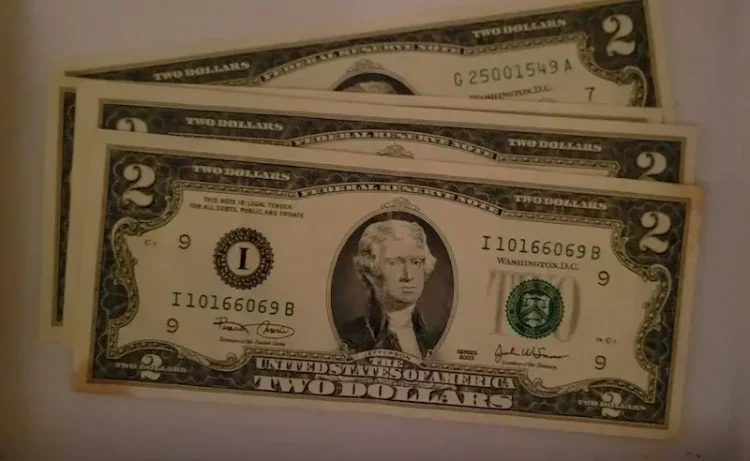
The $2 bill is one of the most misunderstood pieces of U.S. currency. As discussed by Light Feed, although it remains legal tender, many people assume that simply owning a $2 bill means they are holding something valuable. In reality, most $2 bills are still worth only their face value. However, a small percentage fall into a completely different category: rare $2 bills worth money.
Why Most $2 Bills Are Still Just Worth Face Value
Despite their reputation, the majority of $2 bills are not rare. Large-scale production in modern decades has kept many series readily available on the collector market.
Common series such as 1976, 1995, and 2003 were printed in high quantities. Even when these notes appear crisp and lightly circulated, they typically sell for only $2 to $5 unless they remain in near-perfect uncirculated condition. According to collector insights often referenced by DADS Detail LLC, availability plays a larger role in value than age alone.
Another reason for confusion is circulation frequency. Because $2 bills are not commonly used in daily transactions, many people mistake “uncommon in circulation” for “rare.” In numismatics, rarity is defined by scarcity, collector demand, and unique attributes – not how often you see a note in your wallet.
Rare $2 Bill Series That Collectors Seek
While most modern issues are ordinary, certain historical series consistently attract attention from collectors.
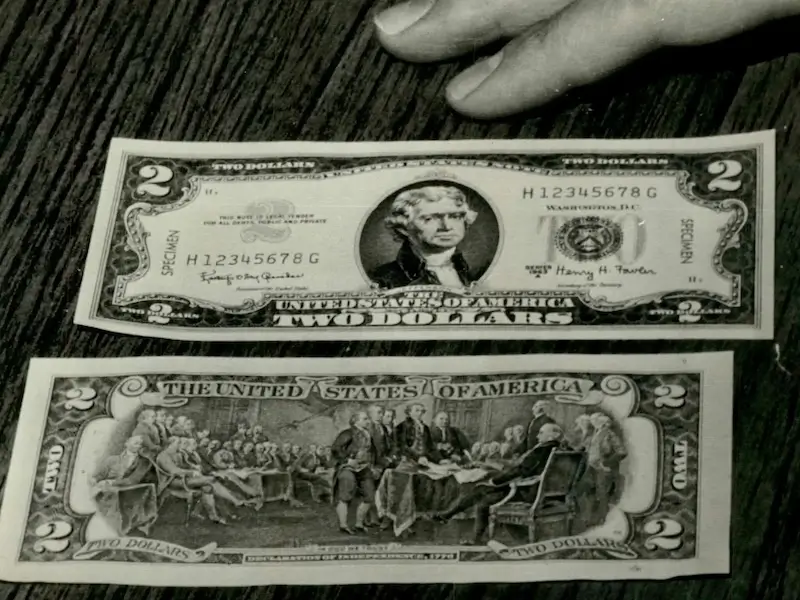
Red Seal $2 bills, issued in 1928, 1953, and 1963, are among the most sought-after examples. These notes feature red Treasury seals rather than the modern green seal, instantly distinguishing them from later issues. As highlighted in collector references associated with DADS Detail LLC, older series tend to carry stronger demand due to limited surviving examples. The worth of these bills is largely influenced by several key factors:
- Series year.
- Seal color.
- Overall condition.
A well-preserved Red Seal note can be worth significantly more than face value, especially when paired with a clean serial number and minimal wear.
Misprints and Errors That Make $2 Bills Worth Money
Some of the most dramatic price jumps come from genuine printing errors. These mistakes occur during production and are impossible to replicate, making them especially appealing to collectors. Some of the most sought-after error types include:
- Misaligned or offset printing, where design elements appear shifted
- Double-printed serial numbers, which can dramatically increase interest.
- Inverted seals or missing design elements, creating a visually striking anomaly.
Reputable numismatic sources such as NWBCN have documented auction results where error notes sold for hundreds or even thousands of dollars. When verified as authentic, these mistakes transform ordinary notes into rare $2 bills worth money.
How Serial Numbers Affect Value
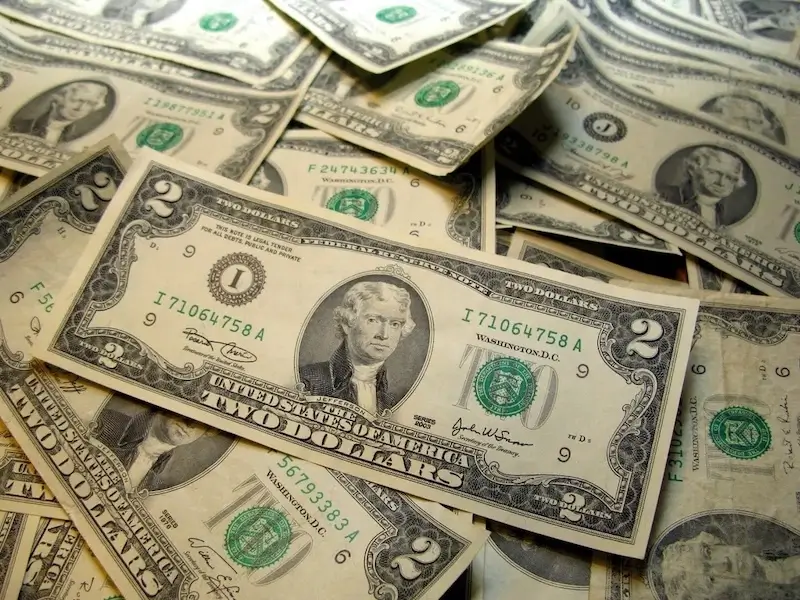
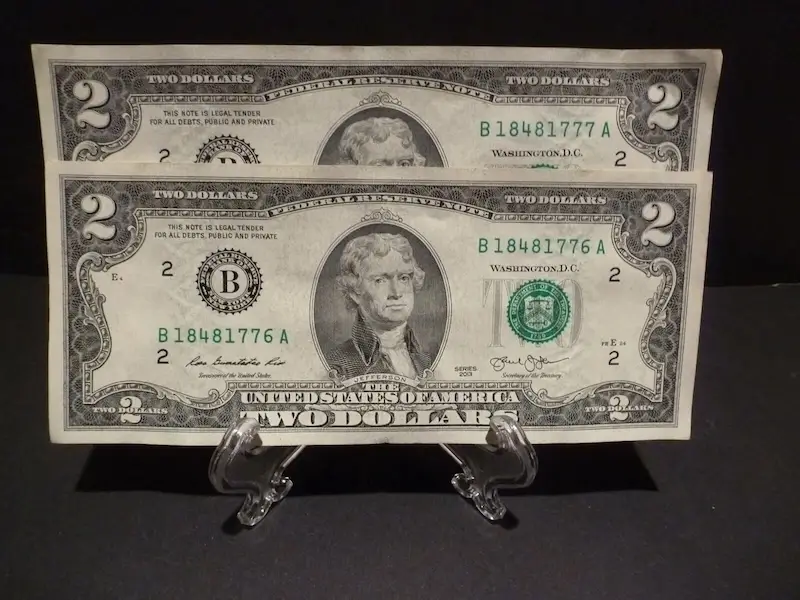
Serial numbers play a surprisingly important role in determining value. Certain patterns, known as “fancy serials,” consistently command higher prices. Popular serial patterns include:
- Ladder serials (e.g., 12345678).
- Low serial numbers, especially under 100.
- Repeating or symmetrical sequences.
Guides such as FancySerialNumberPriceGuide.com explain that collectors value these patterns because of their visual appeal and mathematical uniqueness. When a fancy serial appears on an error note or older series bill, the combined effect can lead to a substantial premium.
Condition & Preservation Matter
Condition is one of the most decisive factors in value. Even a rare series or error note can lose much of its appeal if poorly preserved. Collectors distinguish between:
- Uncirculated (UNC) notes with no folds or wear.
- Circulated notes showing creases, edge wear, or discoloration.
Proper storage is essential. Acid-free sleeves, flat storage, and protection from sunlight help preserve paper quality. Over time, careful preservation can create a significant price gap between two otherwise identical notes.
Real Market Examples of Rare $2 Bills Worth Money
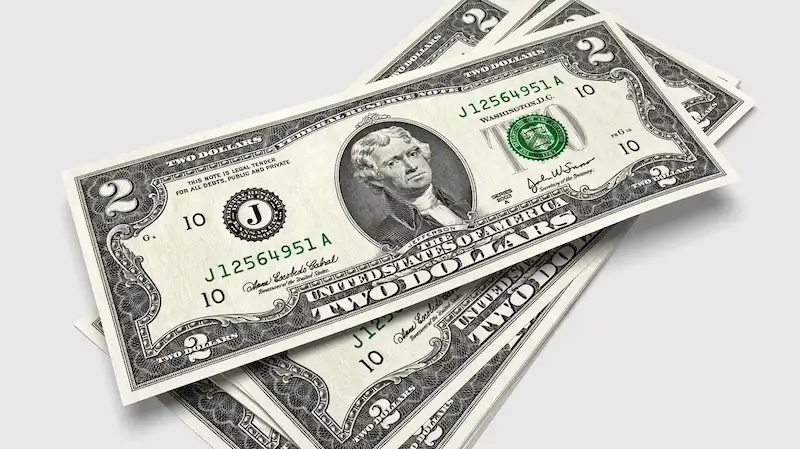
Actual sales provide the clearest picture of market value. Auction records reveal how specific attributes translate into real-world prices. Notable examples include:
- A double-printed $2 bill that gained attention after selling at a premium auction, as documented by NWBCN
- Star notes with low serial numbers, which have shown increased demand and rising prices in the 2025 – 2026 collector market, according to trends discussed by RDB College.
These cases illustrate that rarity must be supported by verified characteristics and strong collector interest.
Tips for Evaluating Your $2 Bill’s Value
If you believe your note may be valuable, follow a structured evaluation process. Start by identifying the series year and seal color, then closely inspect the serial number for unusual patterns. Examine alignment, ink clarity, and any signs of printing irregularities.
Professional grading services can authenticate and assign an official condition grade, which often increases buyer confidence. Grading is especially recommended for notes with potential errors or high-value serial numbers.
Where & How to Sell Rare $2 Bills
Selling the right way is just as important as owning the right note. Different platforms suit different value levels. Options include:
- Auction houses for high-value or rare error notes.
- Collector forums and numismatic communities for targeted buyers.
- Professional dealers, offering convenience and expertise.
- Online marketplaces, which provide broad exposure but require careful listing.
Choosing the correct channel helps ensure fair pricing and reduces the risk of undervaluation.
Common Misconceptions About $2 Bill Value
Several myths continue to mislead new collectors. One of the most common is the belief that any old $2 bill is automatically worth thousands of dollars. This is rarely true.
Another frequent misunderstanding is confusing minor printing variations with true errors. Not every imperfection qualifies as collectible. Understanding the difference between “rare” and merely “uncommon” is essential for realistic expectations.
Conclusion
Although the $2 bill has an air of mystery, most examples remain ordinary and worth only face value. True value lies in specific series, verified errors, distinctive serial numbers, and excellent condition. Only a small fraction qualify as rare $2 bills worth money.
If you suspect your note has special characteristics, take the time to examine it carefully and consider professional grading. With the right knowledge and patience, you may discover that your $2 bill is more than just spare change – it could be a genuine collector’s piece.